In the second volume of his famous memoir “Poland”, Yekhiel Yeshaye Trunk paints a colourful picture of his aunt, grandmother and other women making the Yom Kippur soul candle. While other memoirs, like that of Mendele Moykher Sforim, Bella Chagall and Pauline Wengeroff describe this ritual as an extremely pious and moving ceremony, Trunk has an altogether different impression. An ardent Bundist and secularist, Trunk was critical of the religious superstition he encountered in his childhood, which he described in multiple places in his memoirs with great comic effect.
One scene with my aunt Royze has become particularly engraved in my memory. It took place one Erev Yom Kiper. At that time, we were already living in the ‘court’ which Grandfather Borekh had built in the middle of a large fruit orchard. Grandmother Khaye had put on the orange silk dress with lace which she wore only on Yom Kiper. As a child, Grandmother Khaye took me with her to Aunt Royze’s dilapidated little house. I used to carry her makhzor – the prayerbook for the high holidays.
Inside, Aunt Royze and a group of old Jewesses were rolling the big wax Yom Kiper candle. Aunt Royze in her Turkish shall and with the funny little bird on her bonnet was moving heaven and earth. She looked like one of the witches from Macbeth, but a folksy, Jewish version. All the women, including Grandmother Khaye, stood around the table crying, wailing and saying tkhines, while Aunt Royze ominously and relentlessly rolled the yellow Yom Kiper candle like one rolls a corpse when preparing it for burial. The atmosphere was of the Day of Reckoning, of death and of the other world.
Aunt Royze didn’t cry, but she kept letting out unexpected sounds with a hoarse, miserable voice, like an old, angered hen. While this mystic and idolatrous ceremony was taking place, Uncle Avromke lay by the stove, vigorously scratching himself. To this day, I can still see this disturbing and decorative image.
Trunk is not the only person to have seen soul candle making as a witchy practice. In Nahum Stutchkoff’s Thesaurus of the Yiddish Language, both kneytlekh-leygn (soul candle making) and feldmestn (cemetery measuring) are found under kishef – magic. A practice often used to pull someone back from the brink of death, cemetery measuring is also listed under “determination and stubbornness,” along with the women’s practices of “raysn kvorim” and “ufraysn dem oren-koydesh” – wailing over graves and over the open Torah ark in shul. Trunk’s witchy Aunt Royze, with her many rituals and remedies, seems to have epitomized these qualities.
In an earlier chapter, Trunk recalls another interesting and magical use Aunt Royze had for her burnt-out Yom Kippur Candles. On his mother’s wedding day, her mother – his Grandmother Khaye – and Aunt Royze perform a number of rituals to protect the bride from the evil eye and other bad mojo that Ashkenazi folklore teaches is attracted to us on happy occasions and moments of transitions. Trunk relates their belief that, on her wedding day the bride would be judged by God as on Yom Kippur, and that the whole of the spirit world was somehow closer and more permeable. Among the various rituals they do to protect his young mother and to ask for a good divine judgement, we find the following:
Aunt Royze, in her Turkish shawl and with her bonnet on her head, did not hold back. She had brought from her home the remains of the melted down wax Yom Kippur candles, which she had been collecting for years. She now lit these soul-candle-pieces in the bride’s house. The candles smoked like chimneys. The sweet smell of melting wax filled the room. Grimacing and waving their hands as if blessing holiday candles, Grandmother Khaye and Aunt Royze said tkhines over the burning Yom-Kippur wax, interspersed with incantations to protect the bride from the evil eye.
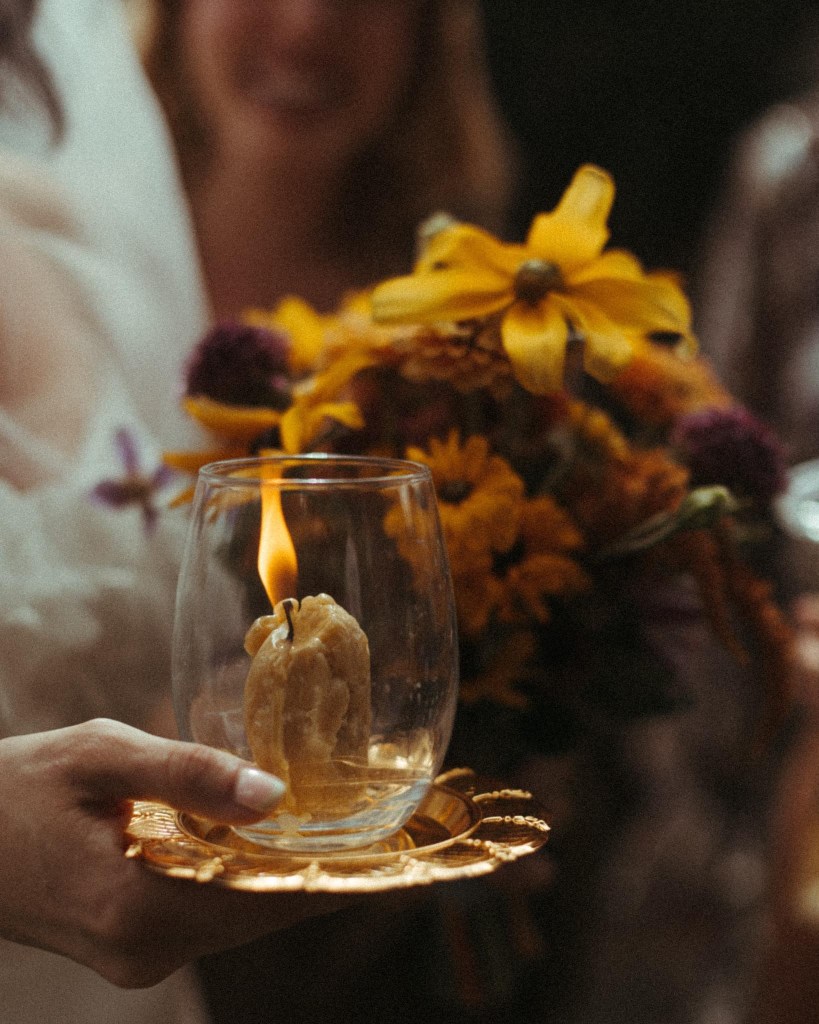
Photo: my friend Joanna carrying the stump of a soul candle as she circled her beloved under the wedding canopy last summer. This custom of the bride circling the groom is also believed to have originated as an act of protection magic, making use of the spiritual permeability and thus power of the bride on her wedding day.
Other sources also reveal that soul candle remains were often kept and used for a variety of remedies or zgules. In his history of Ashkenazi folk medicine, A frog under the tongue, Marek Tuszewicki describes soul candle stumps being used as havdole candles to ensure a good income at the beginning of the working week, as well as to cure ailments like earache (Tuszewicki, 2021, pp. 185-186).
Another source that I recently stumbled across also indicates the importance of soul candle stumps, as well as soul candles themselves, in Ashkenazi Jewish life. In a chronicle of the Jewish community of Vilna during World War One and the German occupation, is a description of a museum founded in 1913 by the “Lovers of Jewish Antiquity” Society, which later became part of the Historical Ethnographic Society founded by S. An-ski in 1919. Among the museum’s collections of ritual and historical object were:
“Stotshikes”—long wax candles, which used to be made from thread which was used to measure the cemetery, and then gifted to synagogues and study houses for torah study etc.”
The inclusion of soul candle stumps alongside other Jewish ritual objects is also a reminder that, witchy as these practices may seem, they were still Jewish traditions, practiced by observant Jewish women for several centuries. Prayers for Soul Candle making are included in Sore Bas Toyvim‘s famous 18th century collection of tkhines, “The Three Gates”, where the ritual is presented as part of the women’s mitsve or religious commandment to kindle shabbat and festival lights. In fact, dating back to the twelfth century, soul candle making is almost as old as this mitsve, which first became considered a women’s religious duty in the medieval period.
In most memoirs – notably those of Bella Chagall, Pauline Wengeroff and Mendele Moykher Sforim, who remembered his mother reciting a version of Sore Bas Toyvim’s tkhine – soul candle making is described not as a witchy practice, but as a deeply spiritual activity, led by the most pious and religiously educated women. It was also practiced in some of the great Hassidic courts, led by the rebetsn and sometimes with the participation of the rebbe. The associated ritual of cemetery measuring was, in Khaim Shoys’ words, also associated with “particularly religious women” – something that Trunk hints at in his description of “the Eyshes Khayil of Hendrikov”.
Rather than seeing these as magical practices that existed for centuries alongside Judaism, I would argue that these rituals are examples of the magical aspects of Judaism itself and of the huge transformations in Jewish practice that have taken place in just the last century. Demonstrating that the so-called disenchantment of the world and of Judaism with it was neither fast nor inevitable, these rituals are a reminder that the line between magic and religion has always been a thin one.
Yekhiel Yeshaye Trunk, Poyln : zikhroynes un bilder. Vol 1-2, (New York, 1945). Trans. Annabel Gottfried Cohen.
H. Lunski, “Di yidishe historish-etnografishe gezelshaft,” in Zalmen Reyzen (ed.), Pinkes far der geshikhte fun Vilne in di yorn fun milkhome un okyupatsye. Historish-etnografishe gezelshaft in nomen fun S. An-ski, Vilna, 1922.
Nahum Stutchkoff, Der Oytser fun der yidisher shprakh. New York, 1950.
Tuszewicki, Marek, A Frog Under the Tongue: Jewish Folk Medicine in Eastern Europe. Liverpool University Press, 2021. Trans. Jessica Taylor-Kucia.
Cite this: Annabel Gottfried Cohen. “She looked one of the witches from Macbeth, but a folksy, Jewish version” – Soul Candle magic from Y. Y. Trunk’s Poland.
 Pulling at Threads
Leave a comment