In the summer of 2018, my little sister Viv got married. Our mother died when she was 2 and I was 4, and I was incredibly honoured when Viv asked me to take mum’s place under the khupe – the wedding canopy. It was only when we were all ready to walk her down the aisle that I suddenly felt the weight of what I was doing, the absence that was going to be marked by my presence. Before we left the room where we were all getting ready, I took Viv aside and asked her if she wanted to do something for mum. Looking relieved that I had brought it up, she said yes immediately. Not knowing what else to do, the three of us – Viv, my dad and I – recited Kaddish, the Jewish mourners’ prayer, in front of her bridesmaids and Marija, our adopted grandma who looked after us the night our mum diedand was now making the final alterations to Viv’s wedding dress.
Back then, I did not know about the practice – widespread in Eastern Europe – of inviting the dead to weddings. In the 19th and even the early 20th century, it was customary in many Jewish communities for an orphaned bride or groom (meaning someone who had lost one or both parents) to be taken to the cemetery on their khupe day. This was often led by a professional zogerin or “preacheress” who would invite the deceased parent to the wedding, giving space for the bride or groom to express their sorrow at their loved one’s absence.
As one might imagine, inviting deceased spirits to any event – especially one as happy and therefore as vulnerable to bad mojo as a wedding – must be handled with care. We learn this in S. Ansky’s famous play the Dybbuk. The bride, Leah, is taken by her aunt to the cemetery before her khupe ceremony. Her aunt warns her that only close blood relatives can be invited, but Leah wanders off and presumably invites her deceased beloved, Khonen, whose spirit possesses her as a dybbuk. Maybe one of the morals of the story is that you should always pay up for a professional zogerin.
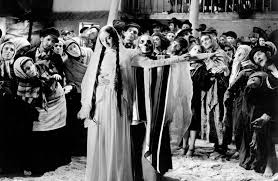
This rule about only inviting blood relatives may be rooted in the widespread belief that on certain occasions – like the anniversaries of their deaths, in the month of Elul and before thecelebrations of immediate family members – the souls of the dead sit by their graves and wait to be visited. While summoning the dead is prohibited, if certain deceased souls are waiting for us to connect to them, then it’s no longer summoning. Indeed, if we don’t invite those lingering souls to their children and grandchildren’s weddings or come to say Kaddish for them on their yortsayts, we could risk offending them.
Recreating the ritual
Whether or not you believe that spirits are hanging around cemeteries waiting for us to include them in our simkhes and special occasions, most people have experienced how the absence of someone we’ve lost is amplified at certain special life events. Professional cemetery zogerins, with their emotional ritual invitations, allowed people to express this sense of loss, at the same time establishing a continued connection with those no longer physically here. While I’m glad we said Kaddish at Viv’s wedding, it also wasn’t quite what I wanted to do. What I wanted was to bring mum closer to us, not to lift her up into the heavens with the memorial prayer. I wanted to say that she was missed and wanted, and to acknowledge how unfair it was for her that she didn’t get to stand under the khupe with her daughter. These are exactly the words zogerins used to say.
Last summer, for the Kohenet smicha (ordination) in which I and 27 others were ordained, I tried recreating this ritual of ancestral invitation for the first time. All of us had deceased beloveds who we wanted to be there. Many of us had lost people during our training, and had witnessed each other’s grief. We were also all processing the news that the Kohenet Hebrew Priestess Institute – which is not only a present-day structure but also represents a lineage and an ancestry – was going to be closing.
The following is a short description of how I conducted the ritual, using what I have learned from sources describing the Eastern European custom. Unlike a shtetl zogerin, working in asmall community where she usually knew everyone, living and dead, I did not know the families, blood and chosen, of most of my fellow kohanot. To prepare for the ritual, I therefore asked everyone who wanted to take part to send me a list of the dead they wanted to invite, and to tell me a bit about them and their relationship, and what they miss about them. I weaved this information into my invitations, for example: “please come to support your grandchild at this moment just as you supported them when you were living” or “please bring the fabulous energy that you brought into every room you stepped into to this day of celebration”
I also, in the words of each invitation, acknowledged what I imagined were the needs of the deceased, and not just what they could bring to the living. I expressed sympathy for them, and not just for their living loved ones, that they would not be able to attend in person. Especially for people who had died young or had difficult lives, I emphasized that this was an invitation to enjoy the celebration and be part of our community.
Another difficulty with trying to recreate this ritual today is that many of us do not live near our loved one’s graves or even have access to them. For this event, I created a virtual cemetery on zoom. I also invited people to send me pictures of those we were inviting, or to bring objects remind them of them to hold or have near them. For protection, I also invited people to bring some salt to throw over their shoulders at the end, and if at any point they felt spooked. (Shouting, clapping, stamping, spitting and saying “tfu tfu tfu”, is also good for this, if Yiddish literature has taught me anything.)
To protect us from unwanted spirits but without restricting the invitations to blood relatives, I began the ceremony with a couple of disclaimers. First, I made it clear that we were inviting, and not summoning anyone. No spirit was obliged to attend. Then, I added that only those we are naming during the ritual are invited. Again, whether you believe in spirits, I think both talking to the dead and setting boundaries with them is a healthy thing to do. Maybe you have lost people who were harmful to you in life, and while you may not wish them any ill will, you don’t want them at your party. Maybe there is someone you do very much want there, but you don’t want their voice to pop into your head telling them that your dress is too revealing just as you are signing your ketubah. These are all words you can weave into your invitation.
Combining two rituals
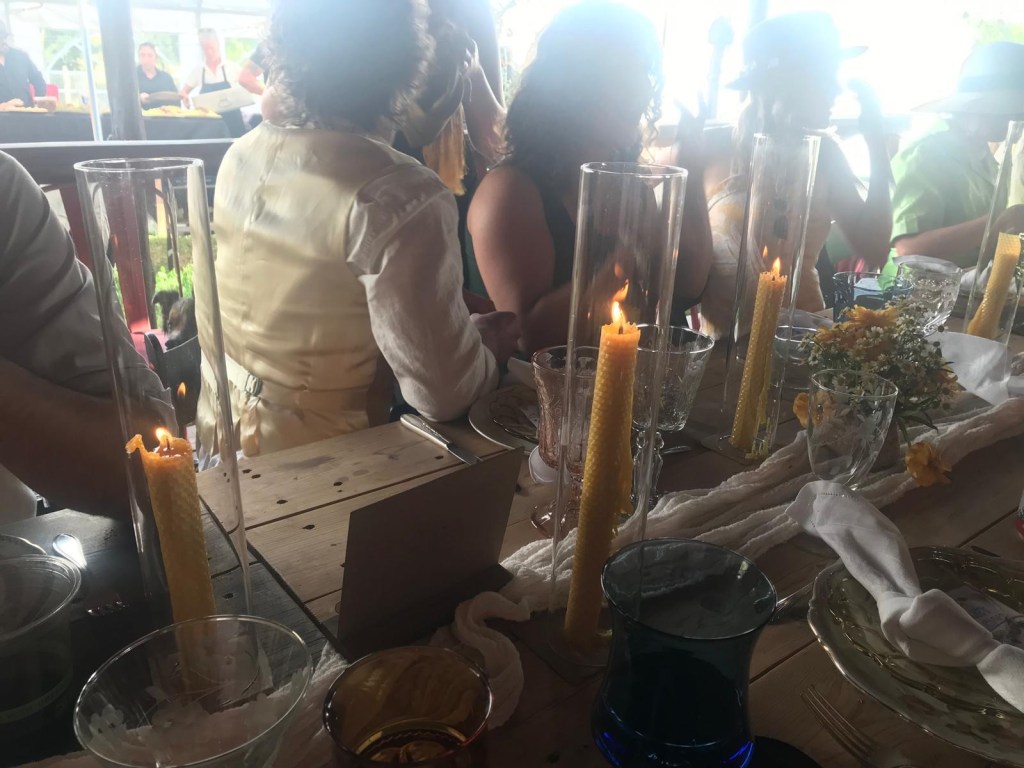
Partly because it’s a ritual I’ve become more comfortable with and partly because, doing this on zoom, I wanted to incorporate a physical element, I decided to make soul candles for the people we were inviting. There isn’t a Jewish cemetery in my town, but there is an ‘ancienne rue des juifs’ – a road near the cathedral where Jews used to live, presumably in the medieval/early modern period. A mostly neglected history, it felt appropriate for a Kohenet ritual. So I measured the road, and used the thread to make candles. The idea was that we would light the candles at our smicha, after reading the tkhine which I’ve included at the end of this post.

Two weeks after Kohenet smicha, a dear friend and member of my cohort got married. Before the wedding, she went to visit her brother and father’s graves, to invite them to the wedding. She also measured both graves, and on the day before the ceremony, we used them to make dozens of candles which were then used to light the wedding feast. It was the most beautiful use of this ritual I’ve seen yet, and I am now helping another couple to make soul candles for their wedding. Note – this is an innovation. In the past, grave measuring was a ritual for times of crisis, rather than happy occasions. But customs are always changing, and crisis are not in short supply. As a powerful and physical way of creating a connection with the dead and through them with each other, making soul candles is a ritual technology that I think has a lot to offer our atomized world.
An ancestor tkhine for Kohenet Smicha, 18 August 2023 / 1 Elul 5783
Source of life, we made these candles in the merit of our beloved dead, as we invited them to bear witness to our Smicha today.
Reboyne shel oylem, di likht hobn mir gemakht inem zkhus fun undzere farshtorbene, vos mir hobn zey farbetn baytsushteynhaynt bay undzer smikhe.
May they who now sit in your presence help us forge a deeper connection to you, weaver of the cycles of time.
Zoln di vos zitsn lebn dayn tron zayn far undz melitsim, vos zolnfarshtarkn undzer batsiung tsu dir, di veberin fun tsayt.
May our conscious forging of connection with our ancestors — both those whose names feature in all our liturgy, and those who have been marginalized, ignored or forgotten — guide us as we embark on our spiritual paths as Kohanot.
Zol undzer bakivndike un keseyderdike batsiung mit undzere oves – di vos me leyent zeyere nemen in ale siders, un di vos me hot zey ignorirt un fargesn — zayn a vegvayzer far undz haynt az mir nemen zikh in gaystikn veg als koyentes.
May you, divine source, remember the merits of all our ancestors – wherever they lived, and whatever language they spoke – and bless us as we walk humbly in their footsteps.
Zolstu, reboyne shel oylem, gendenken in dem zkhus fun ale undzere oves – abi vu zey hobn gelebt, un abi vos far a shprakh zey hobn geredt – un undz bentshn beshas mir geyen anivesdik in zeyere trit.


 Pulling at Threads
Leave a comment