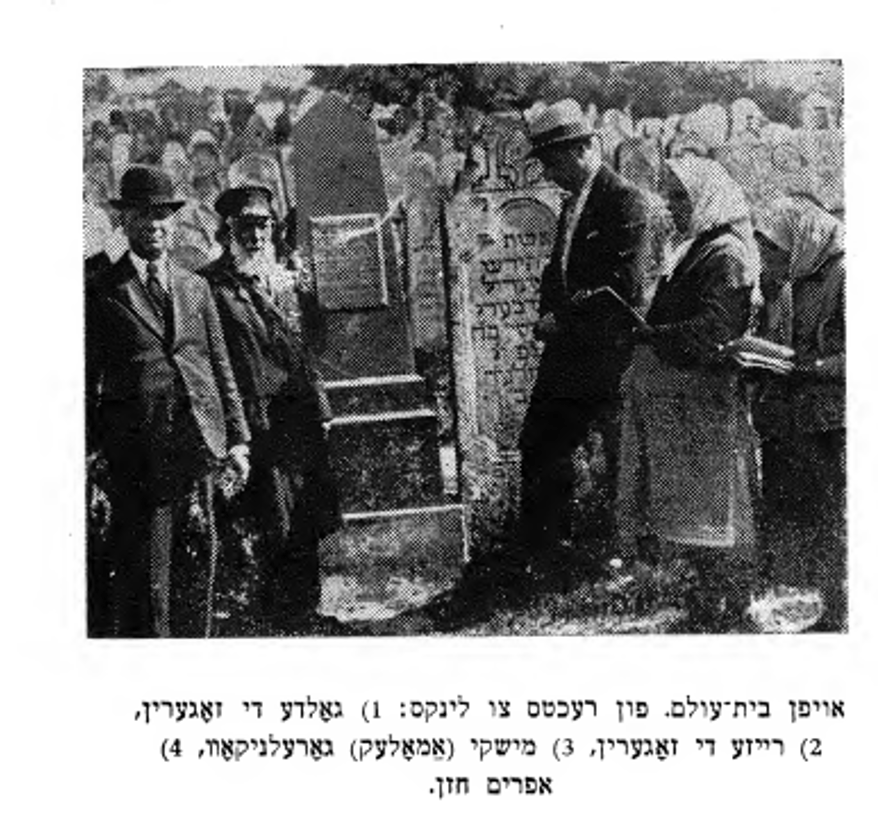
Two zogerins, Golde and Reyze, lead prayers in the cemetery. The photo appears to date from the interwar period. Kremenits, Vizshgorodev un Potshayev : yizker bukh, (Buenos Aires, 1965) 123.
One particularly rich source on cemetery prayer leaders known as zogerins or zogerkes is this yizker bukh dedicated to the pre-war Jewish communities of Kremenets, Vizhgorodek and Potshayev in Ukraine. ‘Cemetery zogerkes’ is even included in a list of professions held by Jews in Kremenets, in between “goose-pluckers” and “mechanics”. This is one of a few sources that tell us that, while many synagogue zogerins led prayers as a mitsve (although some were also paid in donations), cemetery prayer leaders and mourning women were usually paid professionals.

Extract from a list of Kremenets professions in H. Hoygelernter, ‘kurtse geshikhte fun kremenits’ (A short history of Kremenits), Kremenits, Vizshgorodev un Potshayev : yizker bukh, (Buenos Aires, 1965), 13-82 (48).
Below are two translations of extracts from this Yizker Bukh. The first, which compiles two separate entries by H. Hoykhgelernter, describes Leybeshekhe the “Cemetery Jewess” who served Kremenits in the decades before World War One. This is a shortened version of my full translation, which is due to be published in a forthcoming source reader. Anyone who would like to read the full translation for research purposes is welcome to contact me. The second text, taken from Yitskhok Vaksman’s “Memories of der alter heym”, describes another zogerin, Rivke, who worked in the Kremenets cemetery in the interwar period, after Leybeshekhe moved to America. The Yizker bukh also names three other cemetery zogerins who worked in Kremenets and its environs before the Holocaust – Leah, Golda and Reyze.
Leybeshekhe the firzogerin, by H Hoykhgelernter
Mendele the shames was at home with the dead in his synagogue, just as Leybeshekhe, the zogerke, was at home with them in her cemeteries. There, she would deliberate with them heymish and intimately, as one does with God on Yom Kippur. Leybeshekhe the firzogerin quite literally managed – whether by debate, demand, or amicable persuasion – to get the dead to obey her wishes on a daily basis.
To us children, she seemed to come from another realm, and to know everything that took place in ‘the other world’ … Leybeshekhe would talk of her discussions with the dead just like other people spoke of conversations with the living. She talked about those who had been released from their suffering in the grave and now, in the world above, were able to accomplish the things we demand of them. She was on intimate terms with the dead and spoke to them as one would speak to the living.
If someone came to beg for forgiveness by their parents’ grave on a yortsayt or at a time of trouble, Leybeshekhe would lead them to the grave and would rap on the headstone with her stick, as if to wake the corpse. She would call the deceased by their name and announce the person who had come to visit them, then fill them in on all their family’s news.
On the day of a yortsayt, she spoke with quite exceptional eloquence. According to the tradition of the ascension of the soul, it was believed that on the anniversary of their death the deceased would be elevated closer to the divine throne. She could therefore make her case with more confidence, requesting forgiveness for the living, and asking the soul of the deceased to resolutely defend those they had left behind on earth. She asked them to remember the living, just as the living still remember them, the dead.
When an orphan came to invite the dead to their wedding on the day of the khupe ceremony, Leybeshekhe would present her arguments to the deceased soul with the greatest conviction. On such an occasion, either the bride or the groom would lean with their head on the tombstone and quietly weep. She, Leybeshekhe, would comfort the soul in their distress that they would not have the honour of leading their child to the wedding canopy.
‘Khaye’ or ‘Reb Moyshe,’ she said, ‘Your child has come to you to invite you to their wedding. Offer them a mazl tov, that they may be led to the khupe with good luck. May a child be born and named after you. Bless them there in heaven, with luck and with success.’
After a death, when Leybeshekhe came to offer her condolences to the household sitting shive, she made them feel like the deceased’s soul was really floating around the home. She would tell them what she had done that day by the freshly dug grave. Everyone felt that even though the body lay in the cold earth, the soul was keeping warm in the house. They – the soul – hears everything that is said about them. They also cry while the kaddish is said, before they part ways. They, the soul, float behind the white cloth which is hung down over the mirror and gaze at their own reflection there, seeing themselves among the living, who are sitting on low chairs and speaking about them, or thinking about them and feeling them in their hearts.
On the morning of Tishe Bov, Leybeshekhe the zogerke, who brought greetings from the living to the dead all year round on their yortsayts,would knock on the gravestones with her stick to announce to the deceased that their loved ones had come to ask them to forgiveness. If an orphan girl needed to get married after Tishe Bov, she would ask her deceased relatives for forgiveness on the bride’s behalf and invite them to the wedding.
The ‘Cemetery Jewess’, as Leybeshekhe was known, had the honour of finding her resting place in America, in the cemetery in Chicago.
Note : it is worth mentioning here that the only reference I have every heard to an Ashkenazi ‘cemetery woman’ practicing in America, was in Chicago. In a talk I attended with Dr Nathaniel Deutsch, he mentioned hearing about this from elderly members of the Chicago Jewish community.
Rivke the zogerin, by Yitskhok Vaksman
I was orphaned at a young age and at the same time became a father and mother to my five younger brothers and sisters. We used to go to the cemetery often, and I remember Rivke the zogerin, who would go up to the grave and knew exactly where the person in question was buried, and, after knocking on the gravestone, delivered the following kind of speech:
Peace, joy to you and to your resting place. Your son has come out here to cry out his heart and to beg for the health of the orphans
Or:
Your daughter has come to invite you to the wedding of your grandchild
She would suddenly stand up and walk with the other visitor, and their voices lingered in the air and became muffled between the gravestones…
Sources:
H. Hoygelernter, (A short history of Kremenits) (13-82), ‘The Great Synagogue’ (144-148) and ‘Kremenits personalities, folklore and way of life’ (305-326). Kremenits, Vizshgorodev un Potshayev: yizker bukh, (Buenos Aires, 1965).
Yitskhok Vaksman, ‘Memories from ‘der alter heym’ – our town Kremenits’, Kremenits, Vizshgorodev un Potshayev: yizker bukh, (Buenos Aires, 1965).
Cite this: Annabel Gottfried Cohen, ‘The Cemetery Zogerins of Kremenets’, https://pullingatthreads18.wordpress.com/2025/01/26/the-cemetery-zogerins-of-kremenets/
To learn more about cemetery zogerins and the other women’s professions documented on this site, see this new article published in the Jewish Women’s Archive Encyclopedia, which summarises much of my research: https://jwa.org/encyclopedia/article/women-religious-workers-eastern-europe
 Pulling at Threads
Leave a comment