Two years ago, I took a course with Prof. David Fishman on the history of the shtetl. In one of our classes, Prof. Fishman showed us this video of the Belarussian shtetl Novogrudok/Navaredok, filmed in 1931 by former Novogrudok resident, the famous philologist, lexicographer and philanthropist Alexander Harkavy.
About 3 mins 39 seconds in, the camera stops and focuses on the face of a smiling young woman, pictured in the screenshot below. The Russian voice over says ‘Crazy Rivka, everybody knows her. She smiles at every passerby very kindly.’
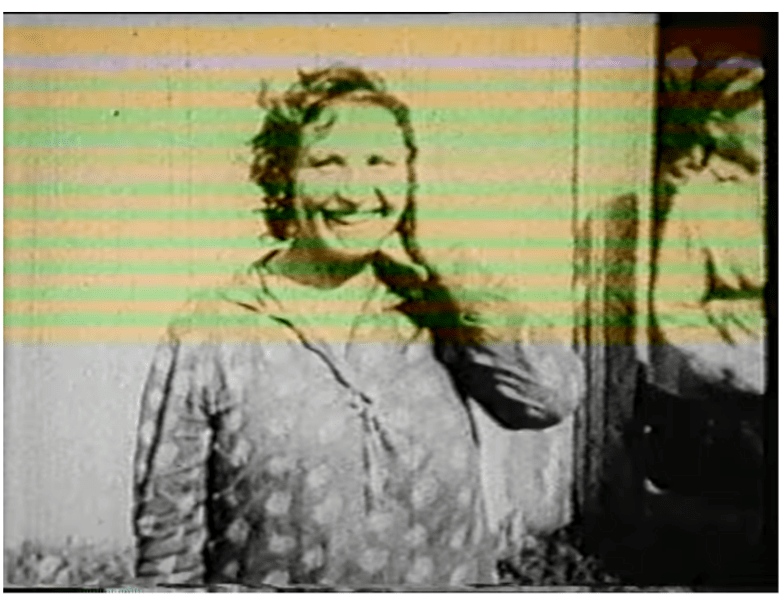
In the Novogrudok memorial book, which is online in English translation, I found the following description of Rifke, daughter of ‘Yoshke the Klipe’ – ‘Yoshke the shrew:’
His [Yoshke’s] only family was his daughter Rifke, a hefty maiden with rosy cheeks and big, expressionless eyes. She gazed at everyone. She went about barefoot in all seasons. She had her customers, where she cleaned their houses. But most often she followed Riva the midwife. She was a quite [sic] person and did not bother anyone. But, despite of this, she was called ‘Riva [sic] the crazy one’.
(Eliezer Yerushalmi, ‘Peculiar types of People’, Pinkes Navaredok, (Tel Aviv, 1963) Trans. Oskar Delatycki z”l.)
I couldn’t find anything in the book about Riva the midwife, but below in the same section is a description of Yerushalmi’s grandmother or “bobe”, Tzinke, who was the midwife in the small neighbouring town, Wselub. Like most official and unofficial midwives, Tzinke was also a gifted healer, particularly skilled in ‘pouring lead’ – a remedy we come across often in Yiddish texts, which was used both for healing and for predicting the future.
Like most midwives and many of the other women religious leaders I’ve study, she was well-educated, knew Hebrew, and was a deeply pious and respected woman. Reflecting the common belief that, as a reward for her holy work, a midwife would be admitted immediate entry to heaven when she died, Bobe Tsinke kept a girdle in which she tied a knot for every child she helped to birth, hoping to be buried in it. Murdered in the Holocaust, she was denied a proper burial, and I share her story here to honour her memory.
Though she was old, she managed to earn enough for her upkeep and did not have to rely on help from her children. Bobe Tzinke was renowned in all the villages around Wselub as an extraordinary healer by pouring lead. If somebody fell ill and the doctors could not help him, he would be taken to bobe Tzinke. She poured hot lead into a basin of cold water over the head of the sick. The head was covered with a sheet. She did the pouring from three to seven times, whilst uttering certain incantations. The sick began to feel better and most did recover.
Most of the sick suffered from melancholy and lost strength from their affliction. She had a few patients every day and this is how she earned a living. She always had enough money to spare for the poor. There were several poor families in Wselub which Bobe Tzinke supported, without anybody knowing about it.Though she was old, she managed to earn enough for her upkeep and did not have to rely on help from her children. Bobe Tzinke was renowned in all the villages around Wselub as an extraordinary healer by pouring lead. If somebody fell ill and the doctors could not help him, he would be taken to bobe Tzinke. She poured hot lead into a basin of cold water over the head of the sick. The head was covered with a sheet. She did the pouring from three to seven times, whilst uttering certain incantations. The sick began to feel better and most did recover. Most of the sick suffered from melancholy and lost strength from their affliction. She had a few patients every day and this is how she earned a living. She always had enough money to spare for the poor. There were several poor families in Wselub which Bobe Tzinke supported, without anybody knowing about it.
Bobe Tzinke was also a midwife and practised it for many years. On occasions, when a doctor was called to attend a birth, Bobe Tzinke was called also. She would spend a week with the mother and child. She had a long, beautiful girdle and after each birth she made a knot in the girdle. She asked that the girdle with the knots should be put around her after she died, so that the newly born children would be her reference to allow her an entry to heaven. The money which she earned as a midwife she gave to charity. She would gather donations of food from the wealthy households and distribute it to the needy on Thursdays. She went to the synagogue three times a day. Midweek she was the only woman who was representing her gender at the prayers.
Bobe Tzinke, with all other Jews of the township of Wselub, was taken by the Germans to Novogrudok, where she was killed and buried in the mass grave of the 4000 [more than 5000] victims in the Koshelevo [Skrydlevo] ditches.
(Eliezer Yerushalmi, ‘Peculiar types of People’, Pinkes Navaredok, (Tel Aviv, 1963) Trans. Oskar Delatycki z”l.)
Cite this: Annabel Gottfried Cohen, Madwomen and midwives from Novogrudok, https://pullingatthreads18.wordpress.com/2025/02/13/madwomen-and-midwives-from-novogrudok/
To learn more about Ashkenazi midwives, healers and other women religious workers, read this article in the Jewish Women’s Archive Encylopedia. If you are an intermediate-advanced Yiddish speaker, you can also sign up to this online course with the Workers Circle, to read some of these texts in the original Yiddish.
 Pulling at Threads
Leave a comment