Zogerke, zogerin, or firzogerin – feminine versions of the Yiddish word zoger, announer or preacher – were titles given to female prayer leaders who led the service in the women’s section of the synagogue. Zogerkes also often led other prayer or study sessions for women, for example reading the tsene-urene (the so-called ‘women’s bible) on shabes or leading the making of soul candles for Yom Kippur. The role, which required at least some knowledge of Hebrew, was generally performed by well-educated women from high-status families, and was greatly respected. As I’ve described in some of my posts, emotion was a key component of prayer in traditional Jewish life, and especially of women’s prayer. The role of the zogerin was therefore also to lead this public expression of emotion, and as well as being well-educated in Jewish scripture, zogerins would usually be very talented creators of spontaneous, Yiddish prayer. Like gabete, the title zogerin or zogerke was also sometimes accorded to women who were generally skilled in spiritual matters. As illustrated by Rokhl Brokhes’ short story Di zogerin— performed beautifully here by Alona Bach with music and film editing by Uri Schreter — a zogerin was also someone that other women would come to for advice, blessings and prayers, and it could be quite exhausting work.
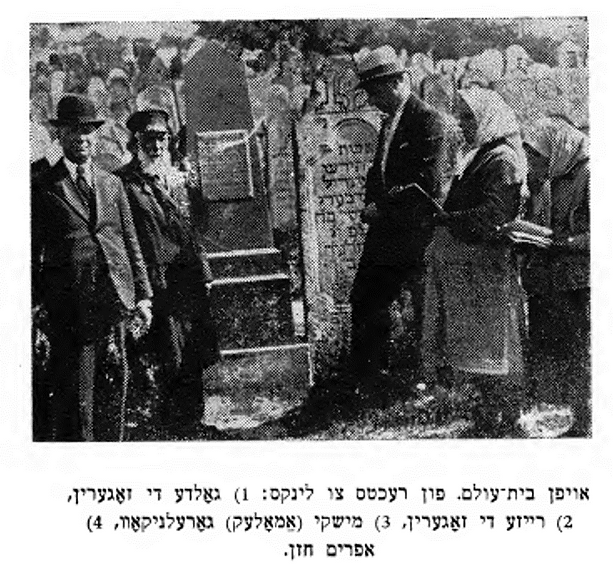
Most people who are familiar with Yiddish and Yiddish culture know of synagogue zogerins and zogerkes. You can read more about them, and their disappearance, in this insightful essay by Dalia Wolfson. However, less well-known is that the same title was also a title given to a type of professional female ritualist who worked in the cemetery, leading prayers and ritual that involved talking to the dead, often to ask for their help. While in some places synagogue zogerins may have also led ritual in the cemetery, in others it is clear that the cemetery zogerin was a distinct, paid role. In the Kremenits memorial book, for example, firzogerin (cemetery)’ is listed among the professions practiced in the shtetl, between “goose pluckers” and “mechanic.”
One particularly common ritual that, in many communities, would be undertaken either by a zogerin or a klogerin, was the bringing a bride – sometimes also a bridegroom – to the cemetery on her wedding day, to invite her deceased relatives to the wedding This custom, featured in S. Ansky’s famous play The Dybbuk, was particularly important in the case of brides and grooms who had lost one or more parents. Another occasion when it was important to visit the dead was on the yortsayt – the anniversary of their death. On both such occasions, it was believed that the spirits were waiting by their graves to be visited by their families. If a family were unable, for whatever reason, to visit a deceased relative on their yorstayt, a zogerin might be paid to go on their behalf, as was the case with Shiphrah Leah of Kletzk.
Zogerins, who in some places were also trusted to remember the important yortsayts of the community, would speak to the dead on behalf of the living, asking for their blessings and sometimes for their help in improvised speeches that to some extent resembled the tkhines said by feldmesterins and the laments of mourning women. They also accompanied people visiting their relatives graves in the months of Elul, or in times of illness and crisis, when it was customary to go and ask the dead to help. Whereas earlier generations of “cemetery women” – as both zogerins and klogerins were known – were known for their spontaneous prayer, by the early twentieth century many cemetery zogerins lead prayers from books, primarly two seventeenth century books of cemetery prayer, the mayne loshn and ma’avar yabok. For this reason, in some places they were known as “mayne loshn women” or “ma’avar yaboknitses”.
In their function as facilitators of a connection between the living and the dead, cemetery zogerkes and feldmesterins are arguably manifestations of the Ba’alat Ov, an archetype of feminine feminine Jewish ritual leadership translated by Jill Hammer as “keeper of ancestor spirits” (Hammer, 2015). As Hammer describes in her chapter on this archetype, Jewish law is somewhat ambivalent and even contradictory regarding what kinds of spirit connection are allowed and kosher. While witchcraft, including communication with the dead, is explicitly banned by the bible and condemned by the Talmud, both are also full of evidence that it continued to be practiced, including by the Rabbis themselves.
In Eastern Europe, connection and communication with the dead remained an important aspect of spiritual life, and one that – as these sources document – was often led by women. However there were also rules and limitations to these practices. In S. An-sky’s the Dybbuk, when the bride Leah goes to the cemetery to invite her relatives to the wedding, she asks her aunt Frayde if she can also invite her deceased beloved, Khonen. Her aunt tells her firmly that she may only invite blood relatives, who, as stated above, were believed to be waiting in the cemetery for their invitation. Perhaps, if Leah had gone to the cemetery with an experienced zogerke rather than the anxious Frayde, who is alarmed by her niece’s attraction to the dead, she may have been better protected and prevented from summoning her beloved, who possesses her as a dybbuk.
 Pulling at Threads