As soon as Rosh Khoydesh Elul comes around, Esther-Khaye the zogerin appears on the scene. For most of the year, we don’t see much of her. She is a quiet, modest Jew, with a shrivelled face. Her hair is always covered by a scarf, both in summer and in winter. Her face and her clothes are the same colour – the colour of sand. Her lips are constantly moving in prayer, and she never has any time to stop and talk. She’s always busy with one task or another – baking bread to sell; looking after her sick husband, the headstone engraver and shames (beadle) of the old synagogue; rushing to the synagogue herself for the prayer service, which, for a fee, she leads in the women’s section. And who said anything about a kdushe? If you want her to pray a kedushah, that will be 10 złoty…
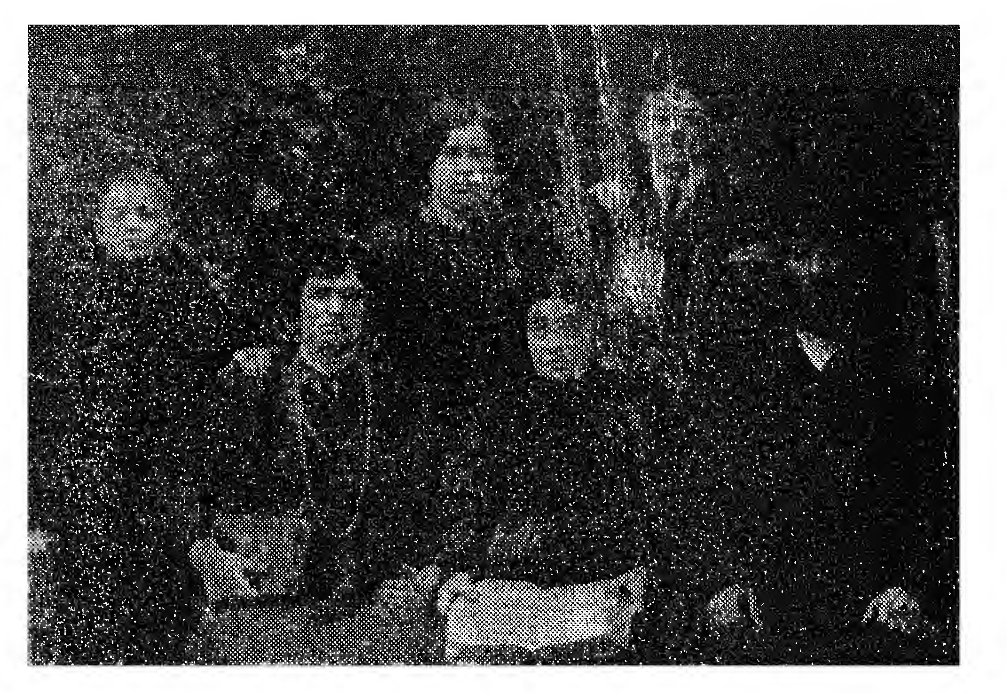
Esther-Khaye the zogerin, with her mother, husband and family. The Yiddish caption doesn’t say which one Esther Khaye is, but I assume she is in the middle holding the open book.
In the month of Elul, there is no one like Esther-Khaye the zogerin. She is the hero of the day. Every minute of her time is gold. Women stand and wait for her as if queuing up to see the greatest celebrity – after all, she is the zogerin for the whole town in the holy place, the cemetery. And not even just for the residents of Zabludov – even out-of-towners, who come to Zabludov to visit their ancestral graves, know Esther-Khaye. Who could have failed to hear of this woman, who can move earth and stone with mere words. Nobody can remain untouched by her words – not even men. Indeed, foolish lads sometimes placed bets, wagering that they’d be able to stand and laugh while Esther-Khaye speaks. But no-one ever managed it. Even these jokers were so deeply touched that they burst into floods of tears.
When someone is struggling in childbirth or becomes seriously ill, people immediately send for Esther-Khaye, asking her to run to the cemetery. Esther-Khaye never needs much instruction, she knows what she must do – no problem, you can rely on her. She already has all her necessary supplies – for example, candles and wick to measure graves – and it is not long before the sufferer starts to feel better.
During the Days of Awe, however, she is something else – a veritable spring of moving words, to which no pen could ever do justice.
From the very start of the Days of Awe, you might observe the following scene in Zabludov: crowds of women head out towards the cemetery, led by Esther-Khaye with her prayers.
The road to the cemetery is not far from the shtetl, and, entering the graveyard, Esther-Khaye immediately feels at home – the headstones are like familiar faces. “Good day, God!” she begins, with a sad tune. “Your servant Esther Khaye has arrived.”
She heads towards a grave, casting a quick glance at the women for whom she needs to pray there, and words start to pour out of her as if from a spring. First, she calls out the name of the deceased, and, knocking three times on their headstone with her hand, she talks to them just as one would to the living.
“Good day to you, Rivke-Mindl, daughter of Yankev-Tsvi. Your daughter, Sore-Rivke, has come to see you and to cry out her bitter heart to you. Take a look, Rivke-Mindl, at what has become of your daughter – it will make you want to lie back down in your grave! Beg for a good year for your daughter, Rivke-Mindl, for a kosher year, in which she will not suffer any hardships. See to it that you take pains for her. Why are you silent? Why do you not entreat with the Master of the Universe? It is now five years since your daughter’s marriage, and still she has not been blessed with a Jewish child. She remains a barren woman. Do not be silent, Rivke-Mindl! Split open the heavens and beg God for her sake, and for the sake of all the Jewish people, who are currently suffering so bitterly. By the merit of this holy undertaking, you will also earn your place in heaven. And let us say “Amen.””
Or another example:
“How can you just lie there at this moment when your daughter needs health and prosperity. Go and make efforts for her, beg the Master of the Universe! You are, after all, closer to him than us sinful living people. Be a good advocate for her, and for all the people of Israel. Vene’emar “Amen.””
And so on and so on. Her words flow without pause. The people gathered around listen intently, wiping their eyes and showering her with blessings her as she speaks. When Esther-Khaye finishes speaking, she straightens her back and takes the few groshn offered to her. Her lips melt into a smile, as if to say, “Well, what do you think, do I know how to do my job or what?!”
Recently, Esther-Khaye the zogerin has been kept busy not just in the month of Elul, but throughout the year, with work from America. Sometimes, an American comes to Zabludov from across the ocean, and wanting to speak to their parents in the afterlife, calls on Esther-Khaye to take them to the cemetery. Other times, she receives orders by mail, from people in America with requests for their dead in the Zabludov cemetery.
Esther-Khaye does her work perfectly. When entreating the dead on behalf of an American, her petitions are quite something else, really demonstrating her incredible talent. For her, the great ocean separating Zabludov simply didn’t exist. Through her words, all residents of Zabludov – past and present, living and dead, along with the emigrants in America – are brought together in one town. After bringing their petitions to the cemetery, she sends each of her overseas clients a letter containing greetings from their beloved dead. She is paid fairly for this work.
And so it is, year-in year-out, we hear Esther-Khaye’s cemetery recitations, always delivered in her familiar, traditional style known and loved by all of us in Zabludov.
Source: Shmuel Lifshits, “Esther Khaye the zogerin” in Zabludoṿe yizker-bukh : di geshikhṭe fun der Yidisher ḳehile Zabludoṿe fun ir breyshes̀ biz ir farṭiliḳung durkh di Natsishe rotsḥim (Buenos Aires, 1961). Translated by Annabel Gottfried Cohen.


Leave a Reply