This short extract from Malke Varad’s memoir of her childhood in Horokhov – published in this Horokhov Yizker Bukh – describes the deep emotion that used to accompany the lighting of soul candles on Yom Kippur. The public expression of emotion was an important part of Ashkenazi women’s religious practice in particular, and one that is frequently described in Yiddish memoirs. The public expression of grief was also something modeled by women religious leaders, particularly those who worked in the cemetery – feldmesterins, zogerins and klogmuters. While many people who grew up in the shtetl remembered the emotional quality of prayer with nostalgia, this text really emphasises its intensity, which could be a lot to handle! This text also tells us that burned out soul candles were sometimes used as havdole candles, and were believed to have healing properties. For more on the use of soul candle stumps, click here.
Yom Kippur in Horokhov by Malke Varad
I didn’t like the “Days of Awe”. They were too heavy and serious. Erev Yom Kiper – the eve of Yom Kippur – was especially intolerable, sinful as that may be to say.
It started when my grandmother, Bobe Sheyndl, was still alive. She used to make two wax candles with her own hands. The big candle for the synagogue had to burn for twenty-four hours, and if any of the candle remained after the festival, it was a sign that this would be a good year. My father would use the remains of the candle as a havdole candle at the end of the sabbath, as a charm for a profitable working week. The second candle was a bit smaller – a “soul candle” – which we lit with the other holiday candles at the start of Yom Kippur.
The two candles were, as I said, made by my grandmother with her own two hands. The day before Yom Kippour, first thing in the morning, she would take a big piece of wax, soak it in warm water, knead it like dough and then pour it over candlewick. For each piece of candlewick, grandmother said a separate prayer, crying as she spoke. This ritual was called leygn-kneytlekh – placing wicks. Naturally, we children liked to stand around watching bringing pieces of wax and making our own little candles.
If the atmosphere was already a little heavy on the day leading up to Yom Kippur, it was far worse that evening, when the candles were lit. My grandmother and my mother would both break down crying and wailing. Soon my aunt Malke would also arrive with her daughters to wish us a khsime toyve – a good judgement – greetings that were accompanied by more crying. They kissed and embraced each other – more crying. This always drove me out of the house and into the garden, where I would wait out the storm in a corner under a tree. But people soon came out to find me, as father wanted to bless the children before he went to synagogue, also with tears in his eyes.
This is how it was during my childhood. In time, everything changed. Grandmother died, and later so did my uncle. Most of her daughters have moved to other parts of the world, only one remained in Horokhov. For a while on Yom Kippur, the women would still gather on the veranda after lighting the candles and before going to shul for kol nidrei, to wish each other a good year. But they no longer cried.
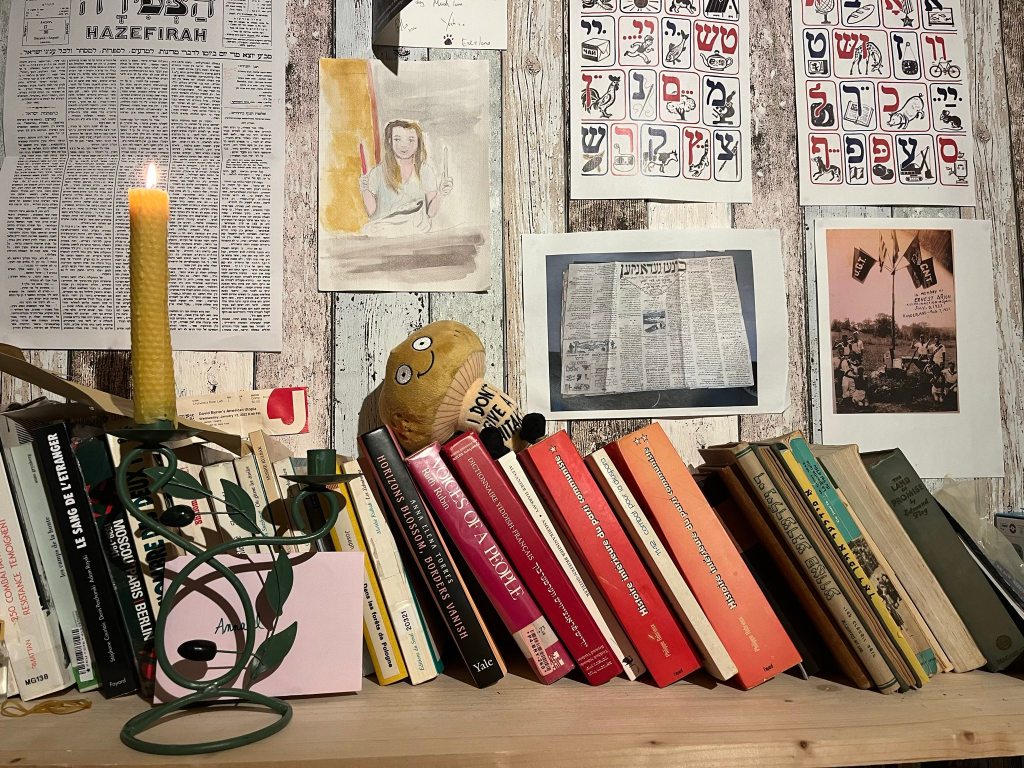
Picture : my soul candle for this year, made from thread that measured the grave of Yiddish socialist poet Morris Rosenfeld.
Source: Extract from Malke Varad, “Yeder yontef mit zayn aromat” – “Every festival had its aroma”, in Yosef Kariv (ed.), Sefer Horokhov (The book of Horokhiv). Tel Aviv, 1966. 47-48. Trans. Annabel Gottfried Cohen
 Pulling at Threads
Leave a comment