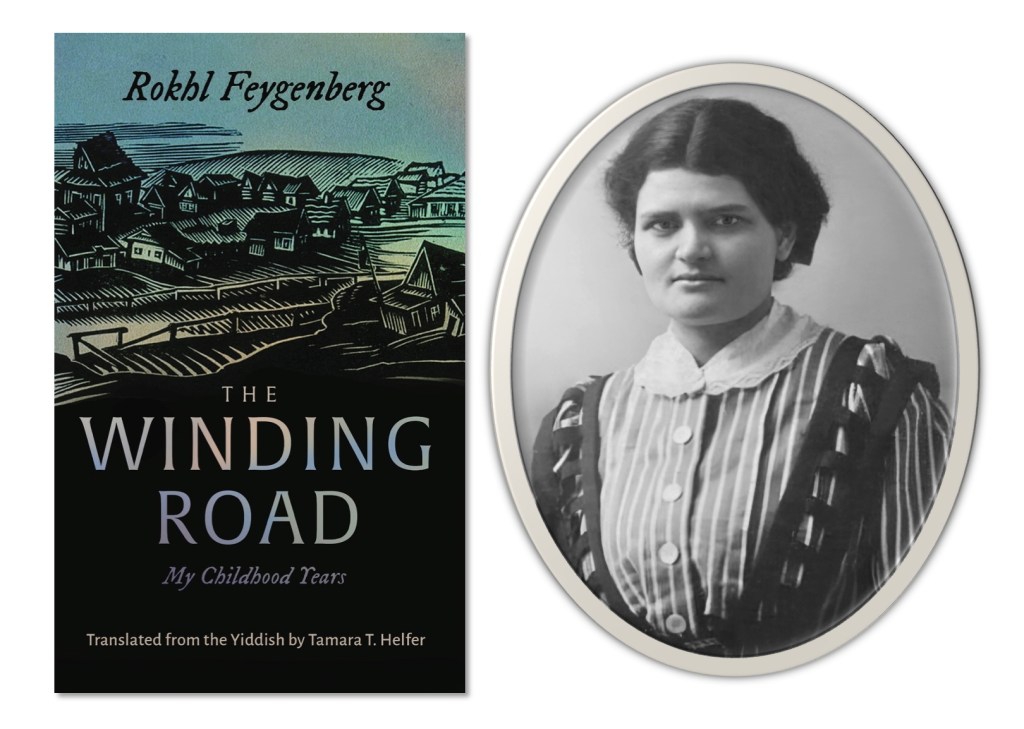
We have just entered Elul, the holy month approaching Rosh Hashanah and Yom Kippur, when Jews in Eastern Europe and particularly Jewish women used to flock to the cemeteries to talk to their ancestors, asking them to act as their advocates from heaven during this period of atonement. I have been working quietly away for a few months now and have some new materials to share, primarily from the Mayne Loshn—a prayer book used by women in the cemetery. But I’m kicking off this Elul with a guest post from Tamara Helfer, who has very kindly agreed to share two excerpts from her new book “The Winding Road”—a translation of the fictionalized memoir of Yiddish writer Rokhl Feygenberg.
These two excerpts describe two occasions when Jewish women would commonly go to the cemetery to pray for and to their ancestors and ask for their help. In the first excerpt, from Chapter 6 of The Winding Road, Rokhl’s mother is dangerously ill, and she goes with her grandmother and two aunts to beseech the soul of her father and other relatives to pray for her mother in the heavenly realm and save her mother’s life. Rokhl’s mother’s friend suggests that they hire a zogerin—a professional “preacheress” and one of the women’s roles documented on this site. But her grandmother, an educated and pious Jewish woman, insists that she does not need a professional, she knows the prayers of the mayne loshn prayer book and is a skilled in the kind of spontaneous prayers and laments (also sometimes described as mayne loshn) performed by women in the cemetery. Rokhl’s descriptions of her grandmother’s prayers and laments are a rare example of these prayers as remembered and recorded by a woman.
The second excerpt, from Chapter 7 of The Winding Road, takes place in the month of Elul and during the Days of Awe. In the days between Rosh Hashanah and Yom Kippur, Rokhl describes how the women of her community gathered to make soul candles, reciting prayers that honored the ancestors and wishing good things for the living in the year to come. In many places, the wicks for these candles were made from thread that had been used to encircle the cemetery or individual graves, in rituals that were accompanied by the kinds of prayers recited by Rokhl’s grandmother in the first excerpt. You can read more about this practice in this section of the site.
With huge thanks to Tamara for sharing her beautiful translation of this incredible source. I strongly encourage everyone interested in Jewish life in Eastern Europe and particularly in the experiences of women to get a copy of The Winding Road, published by Syracuse University Press. You can also read a beautiful article by Tamara about her process of learning Yiddish and translating Feyngenberg’s memoirs here.
The Winding Road
Rokhl Feygenberg was still a teenager when she wrote her lightly fictionalized memoir of her difficult childhood in the Belarusian shtetl of Lyuban in the 1890s. Her 1905 book is now available in a new translation by Tamara Helfer called The Winding Road: My Childhood Years through Syracuse University Press. The Winding Road includes vivid descriptions of daily shtetl life in the late nineteenth century and is especially focused on the experiences of girls and women. For more information about Feygenberg and about the book, including options to purchase, please visit MyWindingRoad.com
A cemetery visit from Chapter 6 “Seltz”
Adapted from “The Winding Road: My Childhood Years,” by Rokhl Feygenberg, translated from the Yiddish by Tamara T. Helfer. Copyright 2026, Syracuse University Press. This excerpt can be found on pages 98-104.
Now, as I looked at my mother, I realized that this holiday would not be as joyful as usual. My grandmother had indeed brought nice things, but they were of no interest to me. I only had eyes for my mother, who looked dreadful, and almost not human: her face was yellow, her lips white, her eyes nearly extinguished, her chest sunken, and her arms emaciated—what had happened to my beautiful mother?! I consoled myself when my mother said that she was doing better, and we could hope to God that she would quickly return to normal. At this, everyone cheered up except my grandmother; her ancient, practical eye had taken in my mother’s appearance, and she understood how my mother was really doing. Since my grandmother had little faith in my mother’s improvement, she began contemplating what to do, and she decided that first off, we should go to the cemetery and remind our ancestors not to forget about us.
“We need to remind them whose life is at stake,” my grandmother told me. “Thank God, there are those in the world to come who know your mother! She has plenty of relatives who can advocate for her there.” My mother had been very dear to her grandfather and her grandmother, and her aunt Kreyne, who had helped my grandmother raise her children, would definitely not remain silent; she would smash through any barriers and go straight to God’s throne to ask him to spare the life of this young woman, this beautiful widow, this mother of small children. Oh, none of them would remain silent! “And it’s not just anybody who will advocate for her,” my grandmother added, “but tsaddikim, whose prayers have real worth. But they need to be reminded.”
My mother’s friend Ester-Musha had already been to the cemetery to appeal to the dead, together with Rivke the zogerin. Rivke could successfully importune the most hardhearted of souls with her prayers, so she would certainly prevail with those who were not so callous. “But it’s not enough for strangers to go,” my grandmother said. “The dead love to be respected, and we ourselves must visit them. You come too, my daughter,” she told me, “You can shed a few tears on your father’s grave too and entreat him to intercede for your mother, so that God will grant her health.”
I listened to her carefully and determined not to forget what I was supposed to say to my father. But I wasn’t able to think for long, because we left right away for the cemetery: me, my grandmother, my aunt Zlata, and my aunt Tsipe. Ester-Musha said that we should bring along Rivke the zogerin as well, because it would be unbecoming to go without her, but my grandmother scoffed at the idea. “What do you mean?” she said. “Are we some kind of public bath attendants? We don’t know Hebrew? We can read the Mayne-loshn as well as the zogerins.” The Mayne-loshn, I knew, was the book of prayers one said in a cemetery. “So what do we need her for?”
And truth be told, we did not dishonor ourselves on those worthy premises. As soon as we arrived, the caretakers recognized that we were not simple women, since every one of us held our own Mayne-loshn, and they could see we were well educated. But they were even more impressed when we told them whose graves we were there to see, because we were going to visit such eminent people. My father’s name had the strongest effect on them, and we went to visit him first. Even though some of our other intercessors were older than my father, his reputation surpassed them all.
I had never been to my father’s grave, and I could hardly wait; I expected something wondrous to behold. I walked on, reading the names on the graves. At last we stopped by a simple wooden marker where my father’s eminent name shone out, along with all his honorifics, which were so numerous they completely filled the board. As I slowly read through the descriptions, I thought what a great man my father had been. All of my father’s titles, and those of his grandfathers, I took onto myself, and a shiver of pride passed through my bones. My head lifted as if I were exalted, and I stood like a true princess.
I compared my father’s gravestone to those of strangers. On the others were written only a few cold words, while on my father’s, I read: Son of the rabbi, the eminent Talmudist, the tsaddik, the prominent scholar, the glory of Israel, and on, and on…I was so absorbed with my father’s considerable reputation that I completely forgot what was happening around me, and why I had come. I would have stood engrossed in my thoughts even longer, but my grandmother yanked my arm; why was I standing there so distracted? When I looked up, I saw that my grandmother and my aunts had tears flowing down their cheeks. They weren’t even reading the Mayne-loshn, but the words that came out of their mouths could have come straight from it. They spoke as fluently as if they were reading from a prayerbook; even stones could have been moved by their lamentations.
I was jealous that they could speak so well. I wanted to say something too, but I didn’t know where to begin. I began to read from the Mayne-loshn, but it sounded ridiculous; I sounded like someone who was reading the Haggadah at a joyful Passover seder, and I wouldn’t be able to cry unless I started hitting myself. I was beside myself and thoroughly ashamed; my grandmother and my aunts would certainly think I was a complete fool for not understanding that I was supposed to weep. But what could I do? I wanted to cry, but no tears came, and to present arguments like theirs was something I also couldn’t do. I didn’t know what to do, and I could hardly wait for them to move on from my father’s grave.
I did not go to the rest of the graves. I sat indoors with the gravedigger until they came to get me. I had to wait a good bit, since they spent some time at the other graves importuning the dead and persuading them what needed to be done. Since my father was a man, and especially such a great man, they couldn’t really admonish him, or complain to him like they wanted. But over at my great-grandmother’s grave, and at my great-aunt Kreyne’s—there, they could finally let loose. These were not just compassionate and pious people, but they were women. With them, it was easier to feel a connection; they spoke the same language. They too had been unhappy mothers with sick children, so they could sympathize. And of course, we had come to plead on behalf of their favorite child. My great-grandmother and my great-aunt Kreyne would surely remember how hard it had been when my mother grew up; they had stayed up many nights and endured many fasts to nurse her through all her childhood illnesses. They were barely able to raise her. And she was so beautiful, talented, and smart!
“But does she deserve a premature end, mother-in-law, like the rebel Korakh?” my grandmother screamed. “Why should such a young tree be torn down? You must not remain silent. May your merits protect her!” My grandmother rapped on the gravestone so my great-grandmother would listen. My mother was just as dear to the dead as she was to the living, but the dead knew better what to do. Now that my great-grandmother was a holy soul, she could reach places where the living could not go, and pray for her there….So if she could help, she simply must!
It was already quite late when my grandmother and my aunts finished their visits at the cemetery. We couldn’t walk back, because we all had fasted and they were exhausted from crying, so we took a droshky. My grandmother felt very unwell during the ride, but I knew this was not from fasting. There was nothing new about fasting for her. She almost always fasted on Mondays and Thursdays. She fasted on the Ten Days of Repentance between Rosh Hashanah and Yom Kippur, and aside from these, on the other fast days throughout the year. And then there were the vows and fasts that arose on ordinary days. If it happened that you didn’t have enough time to pray, then you could find yourself at two o’clock without having eaten; by that time, it was hardly worth it, since it would soon be night and time to break fast. By my reckoning, my grandmother fasted three days a week, and the remaining days, it was the same to her if she ate or didn’t. Whenever she had the chance to starve herself a bit, so much the better—any opportunity to torment her body. So what if she had eaten a good meal instead? There would just be a bit more flesh for the worms in her grave! In our foolish world, these things just don’t matter. This is what my grandmother used to say, when her children begged her not to mortify herself.
So I understood that, when my grandmother’s head hurt as we left the cemetery, it was not because she had fasted. She had bigger concerns. She had seen her ailing daughter with her own two eyes.
Soul Candle making from Chapter 7, “Things Deteriorate”
Adapted from “The Winding Road: My Childhood Years,” by Rokhl Feygenberg, translated from the Yiddish by Tamara T. Helfer. Copyright 2026, Syracuse University Press. This excerpt can be found on pages 127-8.
My grandmother was immersed in piety from the first day of the month of Elul; she prayed all the time, read tkhines, and fasted every day. On Rosh Hashanah, someone brought the shofar to our home so my mother could hear it. Erev Yom Kippur arrived, and my grandmother didn’t know what to do first. There were perhaps ten kinds of prayers to be said, with another tkhine every hour, and also the kapores ceremony of atonement. And then there was the candle making. Some ten or fifteen women gathered at our neighbor Malke-Rokhl’s, and everyone brought the small pieces of wax or bits of braided havdalah candles that were left over from the entire year, and each woman made a huge candle. The candle making was such a tumult that you could go deaf from the racket. Some of the women shaped their wax in a kneading trough, while others set their candles to dry on a stand while they wailed tkhines. Malke-Rokhl outshouted them all. She had to talk to everyone: she asked this one how much the wax had cost her; the second, if her tzimmes had turned out well for dinner; the third, if she had a choice kapores; and other such things. By the time each candle was finished, everyone had wished each other all sorts of good things, however trivial; sometimes I thought only a mad dog would have cared about the ridiculous things they said. But this did no harm to the work at hand. The tkhines were wailed, and they laid wicks in the candles to honor the souls of our holy ancestors. Malke-Rokhl also laid a wick for the matriarch Rachel*, and my grandmother did the same, thereby praying for God to quickly bring her to the places she had been the previous year.
My grandmother finished making her candle, which she stuck in a large pot filled with sand.
*Tamara offers her thanks to Rokhl Kaffrissen for kindly pointing out the reference to the matriarch Rachel in this passage. The reference is missing in the 1909 edition of “Di kinder yohren”, and from the published translation, but has been re-added here. Soul candle tkhines frequently included prayers to biblical ancestors and especially to biblical women.


Leave a Reply