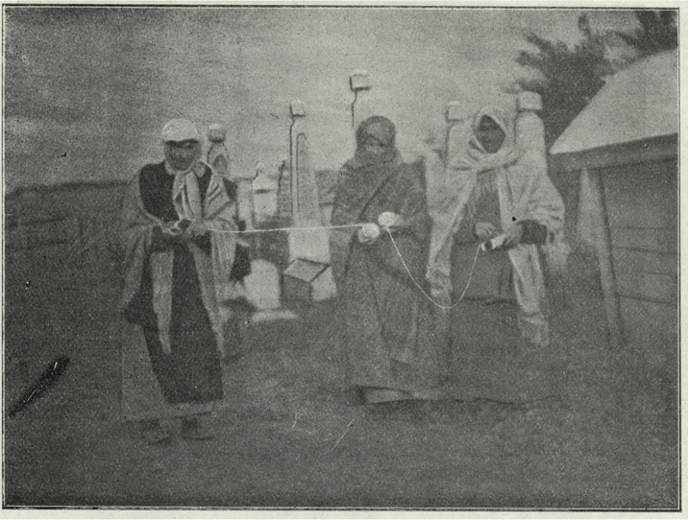
Three feldmesterins in South Russia c. 1906, Courtesy HathiTrust.
As Samuel Weissenberg wrote in his 1906 study of grave and cemetery measuring, in some communities, professional feldmesterins or other pious women used to measure the cemetery every day in the last week of Elul. This is a prayer for that practice, from this 1930 edition of the Mayne Loshn, a cemetery prayer book often used by professional cemetery women, which I will post more about in the coming weeks. It follows this very long prayer for encircling (measuring) the cemetery, and was probably said in addition to it.
This prayer is fascinating because it describes exactly how this ritual—and cemetery prayer more broadly—worked. In the month of Elul, and also on new moons, at the end of Shabbat and at some other times of year, souls were believed to linger by their graves, where the living could come to talk to them and bring them requests to take to heaven. In a belief rooted in Jewish mysticism, the act of praying and especially weeping by a grave was believed to activate the nefesh, the most fundamental component of the soul, which then attaches or “cleaves” to other souls and soul components, creating a connection that could bring the prayers of the living to the higher soul components (neshomes) and even to the “sleepers of Hebron”, the matriarchs and patriarchs and Adam and Eve. These righteous higher souls can in turn advocate for the living before God himself in the divine court where decisions are made about the fate of the living, persuading him to overturn bad decrees that would cause us to suffer or even to die, and obtaining good ones that bring good things into our lives.
In its description of this process of awakening the dead in the cemetery, this prayer paraphrases the Zohar, the foundational text of Kabbalah Jewish mysticism. The same section used here is also referenced by Sore Bas Toyvim in her tkhine for making Yom Kippur soul candles, which, according to Chava Weissler, quotes from the popular Yiddish paraphrase of the Zohar, Tsevi Hirsch Hotsh’s Na’alas tsevi (Inheritance of Tsevi). For more on Sore Bas Toyvim’s prayer and its use of Kabbalistic material, as well as an analysis of how much of that material women had access to, I highly recommend Chava Weissler’s book Voices of the Matriarchs, or her article about the tkhines of Sore Bas Toyvim.
This prayer is extremely challenging to translate and, as with my previous post, this is a very rough, literal translation. I am working on some new tradaptations of these prayers with Rabbi Noam Lerman, which I hope we’ll be able to share with the world by next Elul, mirtseshem.
Just to note that because Yiddish is a gendered language, the soul (feminine) is referred to as “she” and the human (masculine) as “he.” Both should more accurately be translated as “it” or “they” in English, but I have decided to keep some of the gendered words so as to have various genders floating around in the prayer. Anyone using this prayer should of course feel free to change the gendered language in a way that feels most comfortable to them. This prayer starts on page 27 of the book linked to above, and finishes on page 35. I have added page numbers and the Hebrew words that are included in the Yiddish to help people who want to follow along with the original.
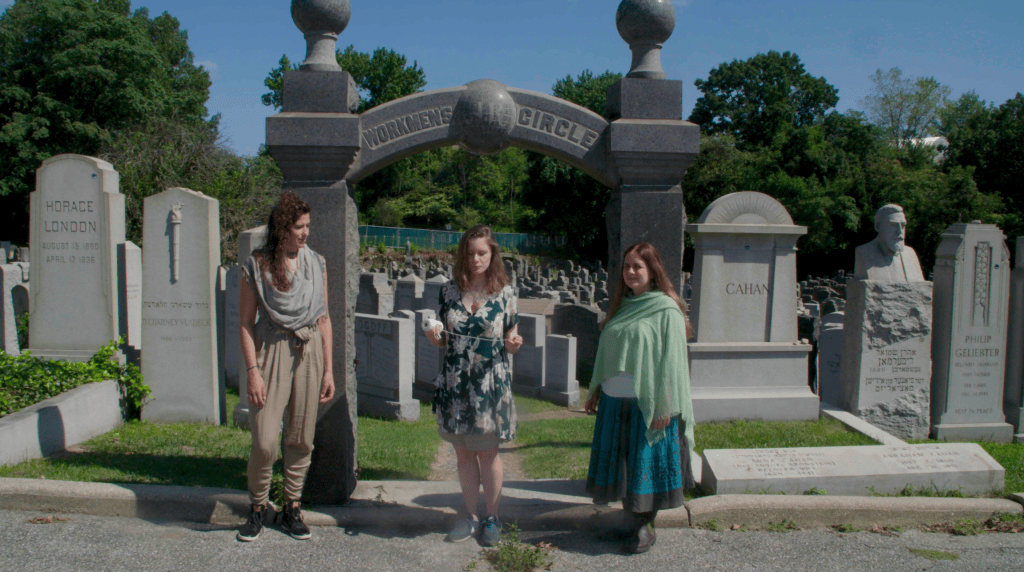
A feldmestn workshop at Mount Carmel cemetery, Queens, led by Annie Gottfried Cohen, Sarah Chandler and Eleonore Weil. Photo by Toney Brown
A prayer for those who encircle the cemetery every day
Peace be upon you holy souls, the tskadikim, and hasidim, the righteous, pious souls that the Eternal One created and put into the flesh of humans so that they could follow God’s commandments at all times. The souls who lived out their lives and peacefully came to join their ancestors, and the souls who died before their time and were delivered to the angel Doyme, (Dumah) who takes charge of newly deceased souls. And the souls who arrived in the chamber and are created anew, like a fruit on a beautiful tree, the souls that become reincarnated like a beloved holy fruit, and the souls that become clear and light thanks to their powerful deeds, and the souls that lived out their days and died according to the judgement that allotted their time to them, and the souls who have not yet paid for their sins. May God have mercy on all these souls, so that their peace may increase, each of them in their rest, each of them in their place [28], with a whole, secure, and peaceful rest among the angels of heaven. And in the shadow of God may they rest under the wings of the angels who are known as kruvim, cherubs, with their beloved ancestors, and from one virtue to the next may you rise towards God. And he who does not have the zokhies, the sacred rights to go into the paved chambers and climb the steps of the ladder that lead to the uppermost heavens, to rejoice in the bright glory of the lord of all lords, may God still favour him and give to him from the bounty of his hand. Just as he revealed his secret to the righteous Moses our teacher, saying “And I will show favour to who I wish and I will show mercy even over those who do not deserve it. For my sake and in my dominion will I give [29] and raise up.”
And I pray that my tfile, my prayer should rise up to God in the appropriate time and that he should answer me when I call him both inwardly and outwardly from the depths of my heart. May my prayer reach all bodies and all spirits. Whoever has did his part and earned his nourishment with good deeds, may God repay his work with double. May it be as if he is among God’s angels who rise up to heaven and bless him with its pleasures and with the knowledge of the secrets of the most high, of their holy names with which they build all worlds. For the nature of God is to be brought up to holiness and never descend back down. May God favour him on the day that he is judged, to let him stand up alive in the world to come. And may the shekhinah rest on their heads. And those who have not yet received their judgement, may God blessed be He cover their sins with his mercy and take away their sadness and the dreadful and terrifying messengers. And those who are in the lowest chambers of hell, may God raise them up and ease their judgement and their sentence, for the sake of the merits of their ancestors. And those who are sentenced to fire and water, may the living God have mercy [30] over them and let cease the smoke from their graves and not let them lose their hope. And the soul who is sentenced to the outermost pit of hell, to ice and to snow and to the flood and the water from above and below, may his Lord forgive him and remove from him his sentence and his sadness, and bring him to his home in heaven that He may heal him from his sins. Among the tents of the ancestors in the great antechamber may He give him to eat from the tree of life and from the tree from which came knowledge of good and evil, and give him knowledge of the kind of things and secrets that are locked up and sealed. And every new moon and every shabes may he send three groups of angels who will be ready to joyfully accompany their souls to the higher levels. And those who have been judged accordingly, may you rejoice in the divine house and the gates of heaven. And save them and forgive them for their sins and gather them beyond the letter of the law to come to their aid. As for the the souls that were divided into more than one body, may God pour over them the dew from heaven, which will bring them back to life. May he pour it over each body, so that the soul is brought into their body, and is called by their name and that body and soul may be bound together.
Forgive your people who are still alive, and those who God has redeemed and separated from their containers, this means their bodies. And the soul that hovers around among the living and whose lips speak in prayer for the living, may you accept her prayer with mercy and may it be your will to fulfill it. And may you turn towards her prayer, both when she prays along quietly and when she screams. And the soul that mellows in the lowest chamber of heaven, may you raise her every shabes and every new moon to the highest chamber of the Garden of Eden, where she can take pleasure in the pure balsam and the scented oil. And when someone has sinned such that their soul can [32] not easily reach that place, and their nefesh [life force] must linger in the world, and their neshome, their soul stands by the door of the Garden of Eden but is not allowed in, may you have mercy on them. And may you allow in the soul that wishes to enter. Ease and remove the suffering of those who are tormented. And at the end of Shabbat, and on the new moon, and on festivals when the souls stand on their graves to praise God with sweet words, may your ears accept their praises and have mercy on us and help us quickly.
And you, holy souls, our hands are outstretched and spread out, because we know for certain that the world needs mercy, for the living are steeped in sorrow and come to pray and entreat by the graves of the dead, and the righteous ones, who are compared to the pillars of the world, they jump up like stags over the hills and mountains and into the heights and they inform [33] the ancestors of the Jewish people, the patriarchs and matriarchs and Adam and Eve who rest in the Cave of Machpela, who are compared to a beautiful rose. And they, the ancestors, go to the lowest chamber of the Garden of Eden, and consult with the souls of the righteous, and issue good decrees, and God, who created the heavens with his word, fulfils his promise to them, to multiply their days and their years and the days of their descendants. And the souls of the righteous are found among the living, to protect them so that the world may continue to exist. Also, when the living go and weep over the graves of these righteous ones, who are worthy to act as intercessors, their souls are awakened in the search for merit and they come together and become joined to each other, and like this they go and rise up to the ancestors, the patriarchs, and they pray and annul all anger and wrath.
You, God Blessed Be He, the mover of all things, accept with mercy and with willingness all of these prayers. And show grace and mercy to those who need it. And make lighter the yoke of those who are judged and punished with hot coals and strong waters and with other kinds of suffering. And treat with fairness also all those from whom no branch or roots or son or grandchild remains to uplift them and help them with their prayers. God Blessed be He, show your [34] loving kindness to him. And do not punish him with your wrath but show him all kinds of mercy to put him right for you know all of his thoughts. For he was only a human. You God gave us knowledge of your good nature and your mercy through Moses our teacher the honest representative of your house. As it is written, “The Lord! The Lord! God, Compassionate and Gracious, Slow to anger and Abundant in Kindness and Truth, Preserver of kindness for thousands of generations, Forgiver of iniquity, willful sin, and error, and Who Cleanses (but does not cleanse completely, recalling the iniquity of parents upon children and grandchildren, to the third and fourth generations).” (Exodus 34:6-7). Hashem has thirteen attributes of mercy, and it is in your name to have mercy over people even when they have sinned. El, God is a powerful God, he rides in a chariot of fire like lighting, but he is merciful and demands mercy before wrath. And all kinds of mercy go before him and he is gracious and gives freely, at least to those whose good deeds can be depended on.
ארך אפים he holds back his anger, both from the righteous and the wicked ורב חסד And turns towards grace so that his creations should not be lost ואמת he is authentic in all the most fundamental forms of truth. And his court, with all three thrones for the wicked, the moderate, and the righteous—these three thrones make just his judgements and his laws. נוצר חסד He shows mercy to two thousand generations. There is no forgetfulness before his throne of glory, and all deeds are written before him. נושׂא עון ופשע והטאה He carries out righteousness and impurity and sins and he lays it all out for good and not for bad ונקה He leaves empty the person who does teshuvah, repentance ולא ינקה and does not empty the person who does not repent, but is stubborn in his wildness פוקד עון אבות על בנים He remembers the sins of a father towards his children if the children repeat deeds similar to those of their father על שלשים ועל רבעים until the third a fourth generation not like the attribute of goodness, for he remembers goodness for two thousand generations. [Translators note: this text was extremely difficult to translate but appears to be listing the thirteen attributes of God’s mercy. If you want to recite this prayer, it may make sense to substitute this paragraph for a list of these attributes like the one found here]
Have mercy over your community [35] Israel, over the living and over those who die, as it is written “And you must know that God your God is a just God, he is an authentic God, he keeps those who love him and who follow his commandments in safety and in Grace.” And you God, may you forgive their sins and help us for the sake of your name. And he is a merciful God and will forgive our sins and will not corrupt and he turns away his anger and all corrupters and he will not awaken his awful wrath as he draws out his sincere judgement towards truth. God, help, that the King should answer us in this day when we call him.


Leave a Reply